

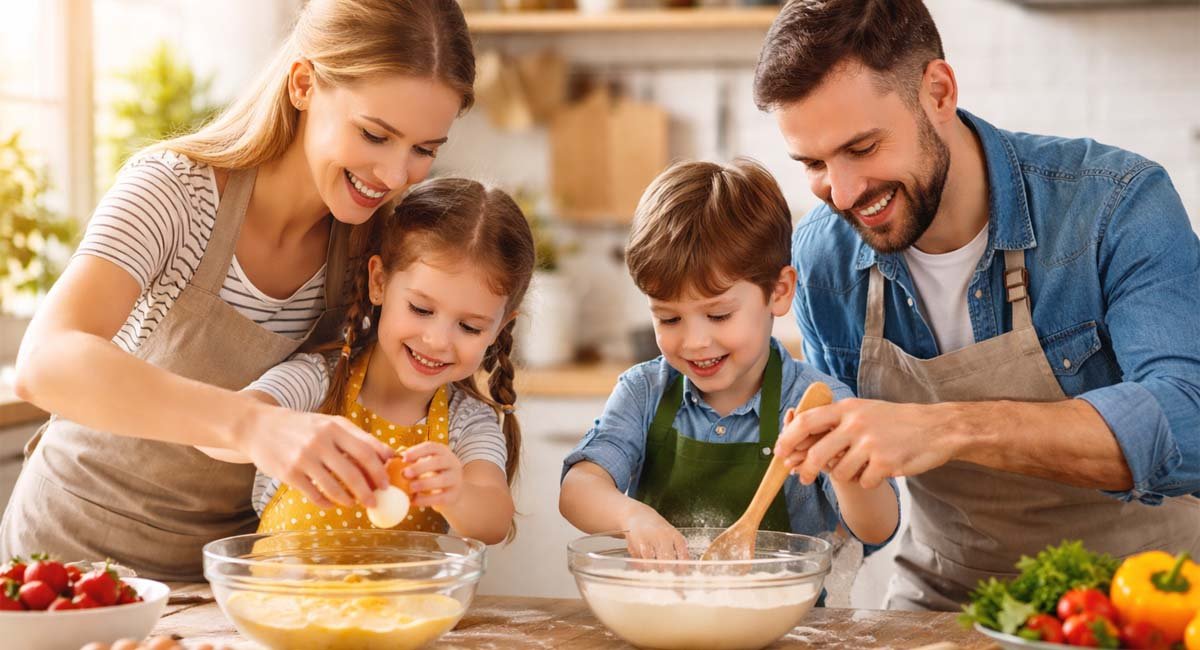
A Guide to Cooking with Children
Cooking with children is about far more than preparing a meal — it’s an opportunity to learn, connect, and build lifelong skills in a relaxed and enjoyable way. From stirring mixtures to choosing ingredients, the kitchen becomes a powerful learning space where children can explore food, confidence, creativity, and independence.
For busy parents, cooking together also offers something invaluable: quality time. It’s a chance to slow down, talk, laugh, and work towards something together — with the added bonus that everyone gets to enjoy the results.
Below, we explore why cooking with children is so beneficial, how to get them involved in an age-appropriate way, and how we support these experiences at WMB Childcare.
Why Cooking with Children Matters
Children are naturally curious, and the kitchen is full of exciting sights, smells, textures, and sounds. When children are invited to take part in cooking, they’re engaging all their senses while learning practical life skills in a real-world setting.
Cooking supports children’s development across multiple areas — cognitive, physical, social, emotional, and nutritional — all through an activity that feels fun rather than instructional.
Cognitive & Learning Benefits
Cooking is packed with early learning opportunities. Following instructions, recognising ingredients, and completing steps in order all help develop important thinking skills.
Some key learning benefits include:
✔️ Early maths skills through counting, weighing, and measuring
✔️ Language development by learning new words, discussing textures and tastes, and following simple recipes
✔️ Problem-solving when things don’t go exactly as planned
✔️ Early science concepts, such as how heat changes food or how mixing alters texture
These experiences help children make meaningful connections between learning and everyday life — something that stays with them far beyond the kitchen.
Physical Development & Motor Skills
Cooking naturally supports both fine and gross motor development.
Activities like:
✔️ Stirring, pouring, and sprinkling improve hand-eye coordination
✔️ Rolling dough and kneading strengthen larger muscle groups
✔️ Using child-safe utensils helps refine fine motor control
All of this supports the physical skills children need for writing, self-care, and independence as they grow.
Social & Emotional Benefits
The kitchen is often the heart of the home — and for children, it can also be a space where confidence grows.
Cooking together helps children:
✔️ Feel included and valued
✔️ Build confidence by completing real tasks
✔️ Learn patience and turn-taking
✔️ Experience teamwork and shared achievement
When children are trusted with small responsibilities, they develop a sense of pride and independence that positively impacts their self-esteem.
Encouraging Healthy Eating Habits
Children are far more likely to try new foods when they’ve helped prepare them. Cooking together gives children a better understanding of where food comes from and encourages a positive relationship with healthy eating.
By involving children in food preparation, parents can:
✔️ Reduce fussiness around food
✔️ Introduce a wider variety of flavours and textures
✔️ Encourage curiosity rather than pressure at mealtimes
These early experiences often lead to healthier food choices later in life.
How to Get Your Child Excited About Cooking
Not every child is instantly enthusiastic — and that’s okay. The key is to make cooking feel playful, not like a chore.
Try:
✔️ Letting your child choose ingredients or colours
✔️ Turning the activity into a story or theme
✔️ Giving them a “special role” such as mixer, measurer, or taste-tester
✔️ Keeping sessions short and pressure-free
When cooking feels fun and child-led, engagement naturally follows.
Health & Safety in the Kitchen
Safety always comes first when cooking with children. Kitchens contain potential hazards, so close supervision is essential.
Simple safety tips include:
✔️ Never leaving children unattended
✔️ Using child-safe utensils
✔️ Teaching hand-washing and hygiene
✔️ Keeping sharp tools and hot surfaces out of reach
✔️ Explaining safety rules clearly and calmly
These moments also offer valuable learning opportunities, helping children understand boundaries and responsibility.
How We Support Cooking Experiences at WMB Childcare
At WMB Childcare, we recognise the importance of practical life skills and early food education. Cooking and food-related activities are thoughtfully incorporated into our learning environments in age-appropriate ways.
Our practitioners:
✔️ Involve children in safe food preparation activities
✔️ Encourage exploration of healthy ingredients
✔️ Use cooking experiences to support learning across the Early Years Foundation Stage
✔️ Promote independence, confidence, and teamwork
✔️ Reinforce hygiene and safety through positive role-modelling
By introducing children to cooking in a supportive, supervised setting, we help build the foundations for healthy habits, confidence, and curiosity — skills that extend well beyond the nursery.
Final Thoughts
Cooking with children is a simple yet powerful way to support development, strengthen family bonds, and nurture a positive relationship with food. Whether it’s baking, preparing snacks, or simply washing vegetables, every small moment in the kitchen can become a meaningful learning experience.
At WMB Childcare, we’re proud to support children and families by embedding these everyday life skills into our approach — helping children grow, learn, and thrive both at nursery and at home.
✨ Secure Your Child’s Place
Spaces are limited for our new term. Give your child the best possible start in a caring, stimulating environment where their confidence and skills will blossom.
📞 Call us today: 0161 205 9067
📧 Email: info@wmbchildcare.co.uk